Rescue of chromosomal misalignments induced by oxidative stress in Biology Diagrams Finally, we describe new developments in our understanding of the immediate consequences of chromosome mis-segregation on the genome stability of daughter cells.

Here, we addressed whether delayed chromosome alignment to the spindle equator increases the rate of chromosome missegregation. Cancer cell lines depleted of Kid, a chromokinesin involved in chromosome congression, showed chromosome alignment with a slight delay, and increased frequency of lagging chromosomes. Chromosomal instability (CIN), the persistent reshuffling of chromosomes during mitosis, is a hallmark of human cancers that contributes to tumor heterogeneity and has been implicated in driving metastasis and altering responses to therapy. Though multiple mechanisms can produce CIN, lagging chromosomes generated from abnormal merotelic attachments are the major cause of CIN in a variety of
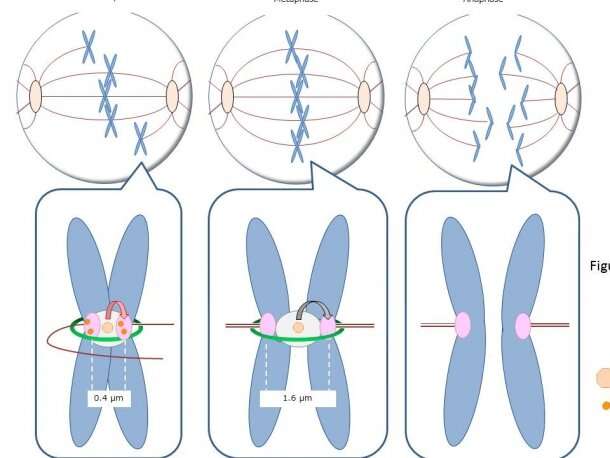
MCAK regulates chromosome alignment but is not necessary for preventing ... Biology Diagrams
Here, we find that the misalignment of chromosomes caused by Spindly depletion is directly provoking spindle misorientation. Chromosome misalignments induced by CLIP‐170 or CENP‐E depletion or by noscapine treatment are similarly accompanied by severe spindle‐positioning defects. Here, we show that premature peripheral spindle positioning causes abnormal kinetochore-microtubule (K-MT) attachments, chromosome misalignment, aneuploidy, and impaired early embryonic development.

CENP-E depletion disrupts the recruitment of key checkpoint proteins, including BubR1, Bub1, KIF2C, and Aurora B, indicating a causal relationship between chromosome misalignment and spindle assembly checkpoint activation in spermatogonia. Our findings demonstrate that CENP-E regulates kinetochore-m … This review focuses on recent progress in understanding non-random chromosome segregation errors in mammalian cells. We discuss the current evidence for non-random chromosome segregation errors in mitosis and meiosis and its various proposed causes. Here, we reveal that CENP-E haploinsufficiency results in chromosome misalignment, spindle disorganization, and metaphase arrest in spermatogonia, which leads to the loss of spermatogonia, chromosomal instability, and spermatogenic disorders.
